

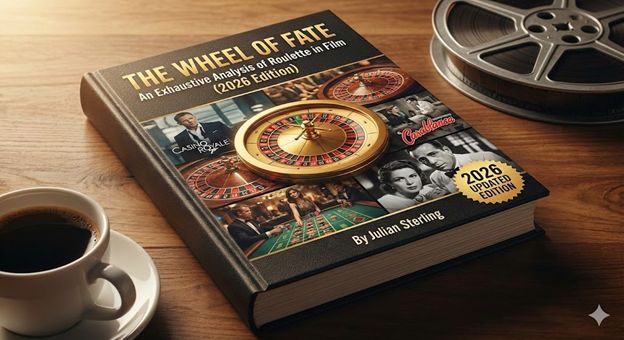
There is hardly a more iconic object in the visual language of cinema than the roulette wheel. It is an ideal circle which encircles a confusion of numbers–a binary scenery of red and black which works upon the horrific indifference of the laws of nature. However, unlike poker, which depends on the psychological weaponry of the bluff, roulette is a battle with the universe itself. The ball recognizes no plot line; it does not fall.
However, almost a century later, filmmakers dictated their will to this random number generator. Looking back through the mirror of the cinematic landscape of 2026, the image of roulette is no longer the romanticized determinism of the Golden Age, but the reduction of the world to the sensual overload of the 70s, and, lastly, the existential, high-stakes thrillers of the mid-2020s.
Join the PERA (Personal Entertainment Research Assistant) waitlist.
The World's Most Indispensable Movie App
The RunPee app tells you the best times to
run & pee during a movie
so you don't miss the best scenes.


Download the RunPee app.
100% free (donation supported)


This essay will dissect the most successful roulette scenes in the filmmaking history genre, looking at their soundscape, gambling moves, and influence on culture, such as the recent 2026 productions, The Ballad of a Small Player and The Rip.
The Romantic Ideal: Rigging the Wheel for Redemption
During the Golden Age of Hollywood, the roulette wheel was hardly left to chance. It was an instrument of the Prerogative of the Owner–a way by which heroes were able to command the laws of probability to the purpose of morality.
What people are saying
about the RunPee app.

Water drinkers unite
Run pee is the best app for people who find themselves needing to pee a lot but also not wanting to miss any action. The app gives you the best times to use the bathroom during a movie while also telling you when to leave and which lines to listen for! It not only gives you the time you should go pee, but it also explains to you what is happening during the break. I helped I use this app every time I go to the movies now. My god father recommended this app to 5 years ago and it’s been in my phone ever since! Highly recommended.
View all reviews
Apple App Store | Google Play Store
Download RunPee app


Casablanca (1942): The Benevolent Fix
The roulette scene in Casablanca continues to be the standard text of all gambling films. It is the ultimate character revelation of Rick Blaine (Humphrey Bogart). While Rick claims, “I stick my neck out for nobody,” the roulette table proves otherwise.
Rick does not give charity when a desperate young couple requires the cash to get exit visas, and this would be an insult to their ego. Rather, he comes to the gambling table and whispers to the husband the famous sentence: Have you tried 22 tonight?
The croupier in charge of the wheel is rigged by Rick, and the number 22 is hit two times in succession. Mathematically, the probability of hitting a given number twice in a row on a single-zero wheel is 1 in 1369 (0.07%). The intervention of Rick goes against the laws of physics to prove the presence of a benevolent god in his cafe. Figure 22 will continue to serve as a reminder of the second chance in 2026 film criticism, making the casino not a location where vice thrives, but a possible location where justice can be found.
Diamonds Are Forever (1971): The Bond Mythos
When Rick Blaine seeks to rig the wheel to charity, James Bond gains control of it by sheer personality. In Diamonds Are Forever, Sean Connery cemented the association of 17 with Bond.
Bond walks into the Whyte House casino with the arrogance of luck and rolls 17. It is also based to a great degree on a true-life legend that Connery supposedly struck 17 three times in a row at the Casino de la Vallée in 1963, a 1 in 50,000 statistical anomaly.
This culturalized the “James Bond Strategy” (a flat betting system that involves high numbers). But as the movie points out, the wheel is not a mathematical puzzle to Bond, but a continuation of his supremacy. The scene introduces the archetype of the suave gambler that up to now exists, combining sexual charm with the violence of the spy movie.
The Metaphysical Spin: Willpower and Chaos Theory
The appearance of the roulette changed as the film industry entered the late 90s. It was no longer the cool fix; it was now a symbol of the metaphysical power of time loops, parallel worlds, and the imposition of human will on an inanimate universe.
Run Lola Run (1998): The Scream
Run Lola Run by Tom Tykwer is the opposite of the cool detachment of James Bond. Lola (Franka Potente) does not seduce the wheel; she terrorizes it.
In the final timeline of this loop-structure film, a disheveled Lola enters a tuxedo-clad casino with only 100 marks. She bets on number 20 (Black). Once winning, she lets it ride. As the ball begins to decelerate for the second spin, Lola emits a glass-shattering scream. It is not just a sound, but a manipulation of the reality of the film. The camera zooms, the editing fractures, and her sheer will forces the ball into the 20 pocket again.
Contemporary analysis sees this in the light of compatibilism. If Lola is roughly 20 years old, betting on her own age signifies a bet on her existence. The scene indicates that there is a universe where there is a multiverse of possibilities and where desperation can bend physics.
The Wonderful Story of Henry Sugar (2023): The Cheat as Ascetic
The 2023 film adaptation of a story by Roald Dahl, by Wes Anderson, presents a stylized alternative. Benedict Cumberbatch plays the role of a man called Henry Sugar, who learns to see without his eyes to cheat at casinos.
More importantly, Anderson does not show the very moment when Henry wins at roulette, but rather emphasizes the ennui of certainty. The movie assumes that gambling can only be exciting due to the risk of losing. When Sugar is able to predict the future dopamine loop is broken. He later refuses the winnings, which is an important remark on the emptiness of the big win.
The Psychology of Desperation: When the Wheel Grinds
Leaving the magical theme aside, a large part of the film depicts roulette as a device of devastation. The scenes are defined by sweat, high contrast light, and the stifling silence of a loss.
Indecent Proposal (1993): The Binary of Ruin
Indecent Proposal has a technically correct and psychologically tormented sequence. David and Diana are a couple in desperate need of dissolving a debt, who place all their money on Red. The ball lands on Black.
This overall defeat forms the vacuum that propels the storyline, commenting on the desperation of the American middle class- a theme that can find a strong echo in the economic atmosphere of 2026. The wheel here is the ” fickle Lady Luck,” and in a few seconds, it is taking away the agency of the couple. Leaving the magical theme aside, a large part of the film depicts roulette as a device of devastation. The scenes are defined by sweat, high contrast light, and the stifling silence of a loss.
Indecent Proposal has a technically correct and psychologically tormented sequence. David and Diana are a couple in desperate need of dissolving a debt, who place all their money on Red. The ball lands on Black.
This overall defeat forms the vacuum that propels the storyline, commenting on the desperation of the American middle class- a theme that can find a strong echo in the economic atmosphere of 2026. The wheel here is the ” fickle Lady Luck,” and in a few seconds, it is taking away the agency of the couple.
California Split (1974): The Numbness of Winning
The masterpiece of Robert Altman breaks down the happy ending. Bill, the main character, embarks on a huge winning streak, making him get 82,000 dollars. His response is, however, not euphoria, but emptiness. There was nothing special in it, he says.
In addiction research, this is quoted as the accurate description of dopamine burnout. The roulette wheel turns out to be yet another machine, and overcoming it is not a spiritual solution.
The Modern Era (2024-2026): Global Stakes and Hybrid Genres
By 2026, the image of roulette has changed to capture the globalization of the business – that is, the relocation to Macau – and a blend of genres.
The Ballad of a Small Player (2025/2026): The Macau Noir
This film, directed by Edward Berger, adapts the aesthetic of Macau Noir. Leaving the Art Deco of Vegas, it takes the audience deep into the hot, sweaty, pressure cookers of Asian gambling cities.
Although the story has Baccarat, the film brings out the essence of the roulette addiction through the personality of “Lord Doyle.” He is a haunting ghost of the tables, who feels that he can read between the lines in disorder. The movie is about how the slippery slope occurs, whereby the game is no longer about money, but about being in the moment of risk.
No Way Out: Roulette (2024): The Societal Game
This South Korean drama turns the wheel into a grim metaphor of a game of bounty hunting by the people. The “Roulette” is a haphazard chance for citizens who could make an assassination attempt to win a cash prize. It uses the idea of Russian Roulette on a societal scale, as a 2026 trend in which gambling dynamics are brought to the societal context andthe gamification of violence.
The Rip (2026): The Tech-Thriller Heist
The Rip is a movie starring Matt Damon and Ben Affleck that reinvents the heist genre in the digital era. Here, the “gamble” is tactical. The precise action of the team is a gamble with their lives, an arranged form of roulette which is nothing compared to the raw luck of the earlier decades.
The Cinematography of Chance
Technical analysis of these scenes shows that there is a regular cinematic grammar that is applied in order to express the tension of the spin.
The “God’s Eye” Shot
In Run Lola Run, as in Croupier (1998), the filmmakers nearly invariably use a direct overhead shot of the wheel. This flattens the depth, making the wheel a 2D geometric abstraction. It highlights how ideal the machine is in contrast to the disorderliness of the human players, forming a visual eye of the storm.
The ASMR of Risk
Sound design in roulette scenes follows a specific envelope:
- Attack: The dealer’s call (“Place your bets”).
- Sustain: The hum of the casino and the clatter of chips—a frequency designed to sound like wealth.
- Decay: The “Rien ne va plus.” The sound drops out, leaving only the whir of the ball.
- Release: The violent clack-clack-clack as the ball hits the frets.
In 2026, films like The Ballad of a Small Player use this auditory landscape to create a hallucinatory quality, where the sound of the game replaces the soundtrack of reality.