

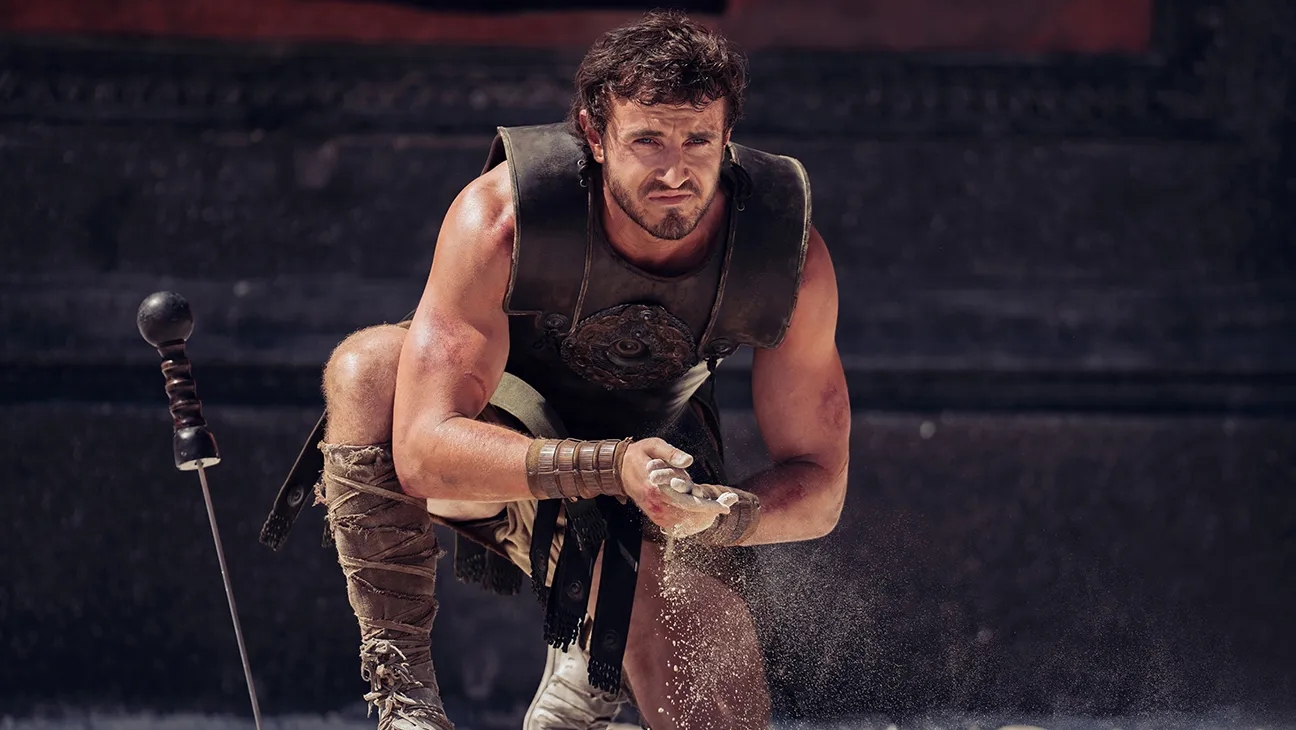
There’s something about ancient Rome that keeps pulling us back. Maybe it’s the sheer ambition of it all. Massive arenas, roaring crowds, emperors who shaped the course of history. Hollywood figured this out a long time ago and filmmakers haven’t stopped chasing that Roman glory since the earliest days of cinema.
Sandals, Swords and the Big Screen
The love affair between Hollywood and the Roman Empire started way back in the silent film era. But things really kicked into high gear during the 1950s and 1960s, when studios were throwing everything they had at the “sword and sandal” genre. You know the type. Huge sets, thousands of extras, costumes that probably took months to stitch together.
Join the PERA (Personal Entertainment Research Assistant) waitlist.
The World's Most Indispensable Movie App
The RunPee app tells you the best times to
run & pee during a movie
so you don't miss the best scenes.


Download the RunPee app.
100% free (donation supported)


Take Ben-Hur (1959), for instance. That chariot race scene? Still gives people goosebumps. The film had one of the largest budgets of its time and swept the Academy Awards with eleven wins. It set the standard for what a Roman epic could look like on screen. Every frame felt enormous, almost overwhelming.
Then there was Spartacus (1960), directed by Stanley Kubrick and starring Kirk Douglas. It told the story of a slave revolt against Rome, and it managed to feel both intimate and grand at the same time. The battle sequences were massive, but the emotional core of the film is what stuck with audiences for decades.
What people are saying
about the RunPee app.

July 30, 2023
My bladder thanks you so much!! App works great for telling u when and for how long you have a pee break! I didn't use the timer function so the dialog in the movie was a great clue as to when to go. I also liked the info about each movie to know whether there was any extra scenes during or after the credits. Nothing worse than waiting for all the credits and then no extra scene.
View all reviews
Apple App Store | Google Play Store
Download RunPee app


The Comeback That Changed Everything
After a bit of a quiet stretch, the Roman epic roared back to life with Ridley Scott’s Gladiator in 2000. Russell Crowe as Maximus became one of the most iconic characters in modern cinema. The Colosseum scenes were intense. The music, composed by Hans Zimmer, was haunting. And the story of a slave turned into a gladiator felt timeless.
Gladiator reminded audiences that these stories still had incredible power. It won five Academy Awards, including Best Picture and it reignited Hollywood’s appetite for ancient settings.
More recently, Ridley Scott returned to Rome with Gladiator II (2024), this time following Lucius, played by Paul Mescal. Scott actually built a partial Colosseum at 40% full scale because, as he put it, constructing it was cheaper than relying entirely on blue screen effects. Denzel Washington and Pedro Pascal rounded out a strong cast and the film brought a fresh energy to the franchise while honoring what made the original so beloved.
And it wasn’t just Scott keeping Rome alive on screen. Roland Emmerich launched Those About to Die on Peacock, a series starring Anthony Hopkins as Emperor Vespasian. It explored the gritty world of gladiatorial combat through a different lens, focusing on the entertainment industry of ancient Rome itself. Meanwhile, Russell Crowe signed on for The Last Druid, playing a Celtic elder defending his people against Roman forces. The man just can’t quit the ancient world and honestly, we’re grateful for that.
Ancient Rome In Modern Culture
What’s fascinating is how Rome’s influence stretches far beyond film and television. The imagery of gladiators, the Colosseum and imperial grandeur has seeped into almost every corner of modern entertainment and culture.
Gaming is a perfect example. Slots themed around ancient Rome have become wildly popular. Titles like Gladiator: Road to Rome use licensed visuals straight from the 2000 film, while Gladiator Legends by Hacksaw Gaming drops players into the arena with cinematic graphics and intense sound design. Sweepstakes platforms like BigPirate, which feature titles from studios like Hacksaw Gaming in their library, have made these kinds of thematic experiences more accessible to casual players who might never set foot in a traditional casino.
The appeal makes perfect sense. Rome represents competition, glory, and spectacle, all ingredients that translate beautifully into interactive entertainment.
Why We Keep Going Back
So why does Rome stick with us? Part of it is the scale. These were people who built structures that still stand two thousand years later. Part of it is the drama. Political intrigue, betrayal, loyalty, the rise and fall of legends. Every great story element is baked right into Roman history.
Hollywood understands this. Every few years, a new generation discovers the roar of the Colosseum crowd, the clang of swords and the weight of an emperor’s decision. And every time, it feels just as thrilling as the first.
Whether you’re watching Russell Crowe whisper about Elysian fields, cheering for Paul Mescal in a packed arena, or spinning through a Roman-themed game, the spectacle of ancient Rome isn’t going anywhere. It’s woven into our storytelling DNA. And if history has taught us anything, that’s a tradition worth keeping alive.